What Competitive Math Really Teaches
Competitive mathematics is not merely about medals, rankings, or admissions. At its best, it trains something far more lasting: the ability to think clearly, struggle honestly, and remain calm in the presence of difficult ideas.
The real curriculum of competitive mathematics is mostly invisible.
Most people think competitive math is about speed. Speed matters, of course. Contests have clocks, rankings, and cutoffs. But speed is only the most visible part of the training. At its best, competitive mathematics teaches something deeper: how to stay with a difficult idea long enough for its structure to become visible.
Picture a student sitting late at night with a geometry problem that refuses to yield. The diagram is crowded with angle marks. She suspects four points might be cyclic, but the right auxiliary line refuses to appear. Three pages are already filled with failed attempts. Nothing works. Frustrated and exhausted, she closes the notebook and goes to sleep.
The next morning, while brushing her teeth, the missing line suddenly appears in her mind. The proof becomes clean, simple, almost inevitable. Something happened overnight. Some quiet part of the mind kept working after conscious effort had stopped.
And in that moment, she learns something deeper than geometry. She learns what real thinking can feel like: slow, uncertain, and then suddenly clear.
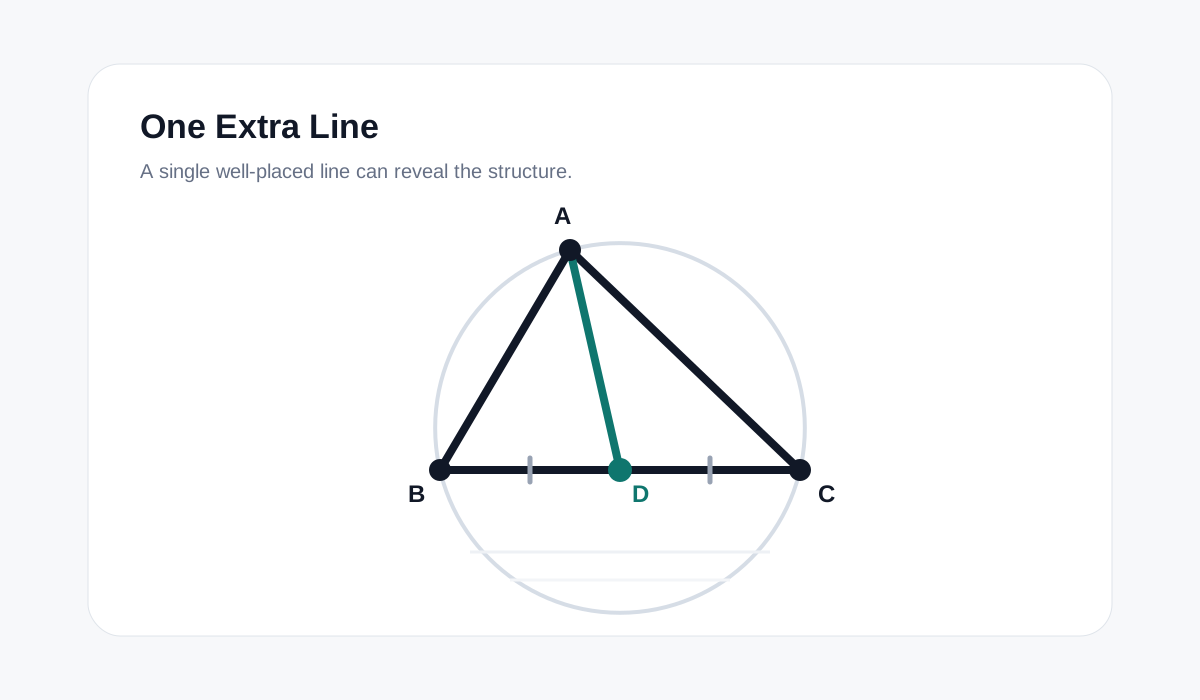
A single well-placed line can reveal the structure.
Difficulty Is Not Failure
Most school mathematics is built around procedures. A method is introduced, examples are practiced, and an exam follows. Many students become good at recognizing familiar patterns without ever experiencing genuine uncertainty.
Competitive mathematics changes the experience. A good olympiad problem is designed to resist easy recognition. You may spend an hour making no visible progress at all.
And slowly, students begin learning the first major lesson of serious thinking:
Being stuck is not a signal to stop.
In ordinary classrooms, confusion often feels like inadequacy. Students begin believing that if they cannot solve something quickly, they are probably not good at it. Healthy olympiad training begins to dismantle this belief.
In serious problem solving, confusion is normal. Everyone is stuck. The question is what you do next.
You draw a better diagram, test small cases, search for patterns, abandon failed approaches, and begin again. Over time, difficulty stops feeling like a verdict. It becomes part of the process itself.
This habit transfers far beyond mathematics. In research, engineering, entrepreneurship, writing, and science, progress often depends on remaining thoughtful while the path forward is still unclear.
The Architecture of Problem Solving
Experienced competition students rarely follow fixed algorithms. Instead, they develop habits of thought for navigating unfamiliar problems.
One of these habits is case decomposition — the ability to break a difficult problem into smaller, more manageable pieces. Clear thinkers know how to divide complexity without losing sight of the whole.
Another is invariant thinking. Some things change constantly, while others quietly remain fixed beneath changing surface details. Competitive mathematics trains students to search for those hidden structures.
What remains true underneath?
Even a tiny example shows the power of this question. Imagine a row of plus and minus signs where each move flips exactly two signs. Starting with all plus signs, can you reach a position with exactly one minus sign? No. The signs may move through many configurations, but the parity of the number of minus signs never changes. Once you see the invariant, the problem stops being a long search and becomes a short proof.
That kind of question belongs not only to mathematics, but to philosophy, systems, economics, and life itself.
Students also learn extremal reasoning. They ask what happens in the largest case, the smallest case, or the worst-case scenario. Choosing the most extreme object in a problem often reveals constraints that were invisible in the middle.
And then there is the strange mathematical instinct toward elegance.
Two proofs may both work, and yet one feels undeniably better: cleaner, deeper, more inevitable. An elegant solution does not merely verify that something is true. It explains why it had to be true.
Over time, students become dissatisfied with solutions that merely work. They begin searching for solutions that illuminate.
Elegance becomes compressed understanding.
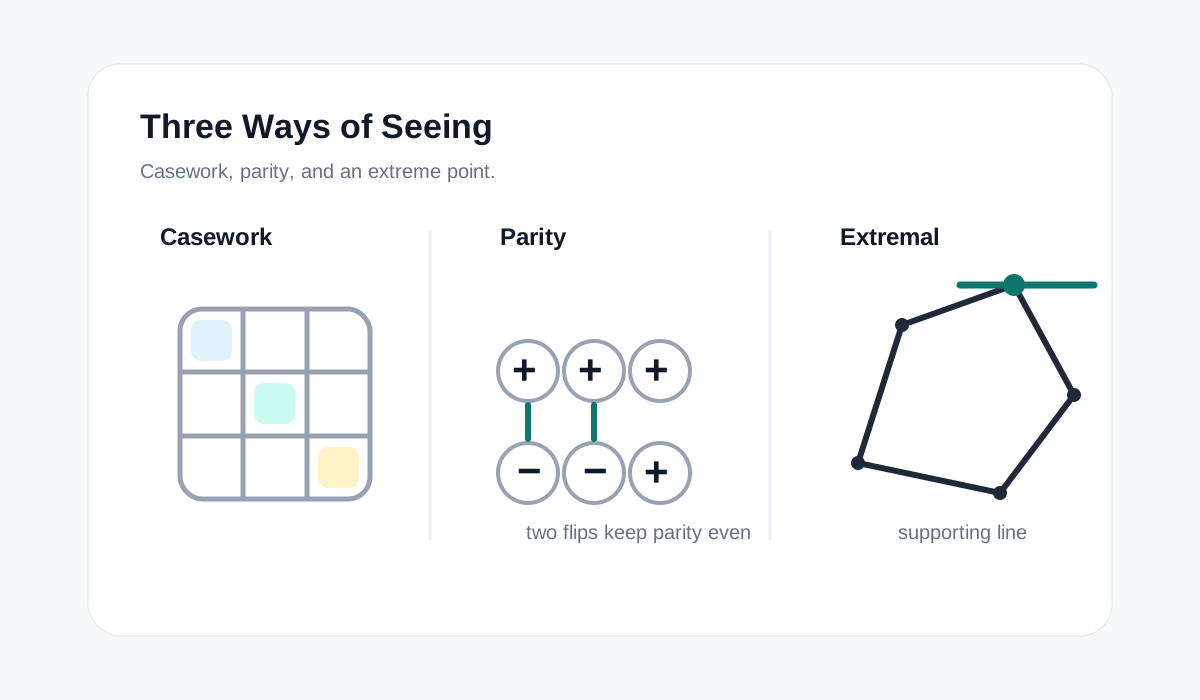
Case decomposition, invariant thinking, and extremal reasoning are habits students can carry far beyond contests.
Precision and Intellectual Honesty
Mathematics is unforgiving toward vague thinking. A proof either works or it does not. A single hidden assumption can collapse an entire argument.
This trains a rare kind of honesty.
You cannot bluff your way through a proof. You cannot negotiate with contradiction. You cannot replace understanding with confidence.
Competitive mathematics teaches students to distinguish between intuition and proof, examples and general truth, feeling correct and actually being correct. A few examples may suggest a pattern. Only a proof explains why the pattern must continue.
This is not merely a mathematical skill. It is a way of respecting reality.
What Failure Begins to Mean
A serious olympiad student fails constantly. Problems remain unsolved, arguments collapse, and simple mistakes ruin beautiful ideas. And yet the student returns the next day and begins again.
Not because failure becomes pleasant, but because its meaning changes.
Failure stops feeling like a verdict on intelligence. It becomes information. A failed proof reveals incomplete understanding. A wrong approach exposes hidden assumptions. An unsuccessful attempt narrows the search space.
Failure becomes informative rather than defeating.
The hardest problems in science, entrepreneurship, and creative work are rarely solved without repeated failed attempts. Competitive mathematics offers unusually concentrated practice in exactly this experience.
Why This Matters More in the Age of AI
Machines can already compute faster than us and generate standard solutions at astonishing speed. But the deeper human task remains.
What should we ask? Which structure matters? Which approach is promising? Which answer is merely plausible, and which one actually explains the problem?
In an age where routine execution is becoming cheaper, judgment becomes more valuable. A machine can expand an expression, check many cases, or produce a familiar-looking proof. But the student still has to notice the right question, recognize the hidden assumption, and decide whether a solution illuminates the problem or merely reaches the answer.
Competitive mathematics trains precisely this kind of judgment. Not mechanical execution, but choice. Not memorization, but insight. Not blind speed, but structured imagination.
The Limits of Competition
None of this means competitive mathematics is perfect. Access is unequal. Rankings can replace curiosity. Coaching can become template memorization under a more prestigious name. Some students attach self-worth entirely to performance, while others become skilled at contest mathematics without developing a genuine love for mathematics itself.
These are real dangers.
The goal is not to romanticize competition. The goal is to recognize that beneath its flaws lies something genuinely valuable when the culture is healthy: an intense encounter with difficulty, repeated over years, structured carefully enough to reshape the habits of thought themselves.
At its best, competitive mathematics is not training students to become faster calculators.
It is training them to become better thinkers.
The Thing That Lasts
Years later, most students will forget the details of particular problems. The medals will sit quietly in drawers. The theorems will fade. The training schedules will disappear.
But something remains.
The result fades. The pattern of thought remains.
A reflex toward difficult problems rather than away from them. A tolerance for uncertainty. A habit of searching for structure beneath confusion. A belief, earned slowly through experience, that understanding often arrives only after long periods of not understanding.
These are not the kinds of things that appear on résumés. But they are among the most valuable intellectual traits a person can develop.
The student who suddenly sees the geometry solution while brushing her teeth may not remember that particular problem years later. But she will remember something more important:
that the human mind, when trained to stay with difficult ideas long enough, can sometimes surprise itself.
And that lesson compounds quietly for a lifetime.
How did this essay land?
Choose any responses that capture your reading.
3 is prime