Why Most Students Never Truly Learn Math
Most students spend years memorizing formulas and solving routine exercises, yet never encounter the true nature of mathematics. This essay explores the difference between mechanical learning and genuine mathematical thinking — where curiosity, structure, and discovery matter more than speed and memorization.
Most students spend more than a decade studying mathematics. They attend classes, solve assignments, memorize formulas, and prepare for examinations year after year. Yet despite this enormous investment of time, very few ever experience what mathematics actually is.
They learn how to perform. They learn how to imitate methods they have seen before. They learn how to recognize patterns in examination questions and reproduce solutions quickly enough to secure marks.
But mathematics itself often remains distant.
The tragedy is not that students find mathematics difficult. Difficulty is natural. Every worthwhile intellectual pursuit demands struggle. The real tragedy is that many students never encounter mathematics in its living form. They encounter only its shadow: a rigid collection of procedures stripped of curiosity, creativity, and discovery.
Real mathematics is not repetition. It is not the mechanical application of formulas to familiar templates. It is not memorizing twenty types of problems before an exam and hoping one of them appears on the paper.
Mathematics begins where curiosity begins.
A student who pauses to ask why a method works has already taken a more meaningful step than someone who solves hundreds of routine exercises mechanically. Questions like these are the true beginning of mathematical thought:
- Why is this statement true?
- Can this idea be generalized?
- What happens if the assumptions change?
- Is there a more elegant solution?
- Can two different ideas be connected?
These questions transform mathematics from a school subject into an exploration.
Consider a simple example.
Many students learn the identity
They memorize it because it appears frequently in textbooks and examinations. Eventually, they become fast at expanding expressions mechanically.
But very few pause to ask where the formula actually comes from.
A student who wants to understand mathematics may draw a square of side length . They may divide it into smaller regions and notice something important: the formula is not merely algebraic manipulation. It is geometry.
The large square contains:
- one square of area ,
- one square of area ,
- and two rectangles of area .
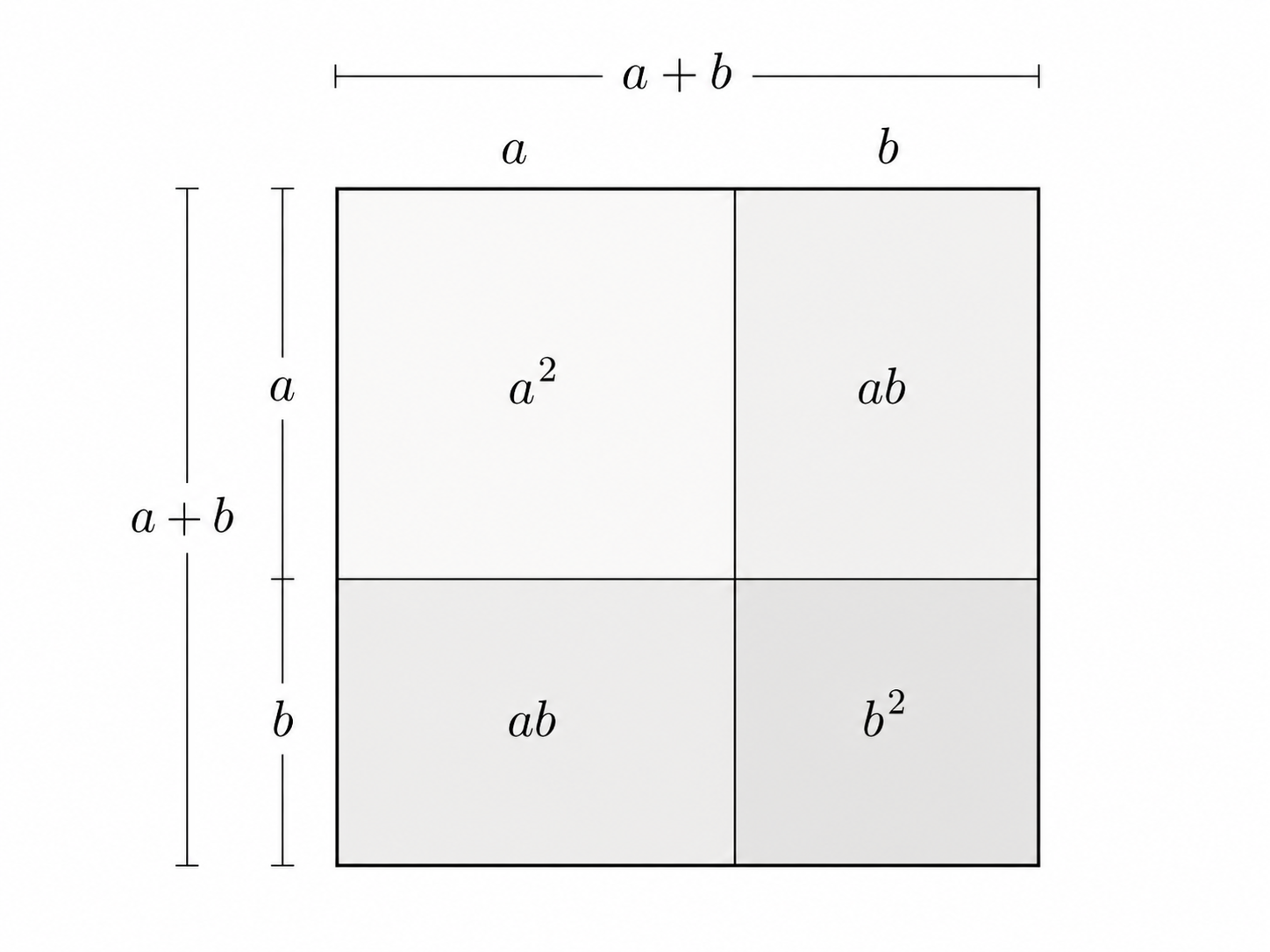
Geometric view of the identity .
The identity stops feeling artificial. It becomes inevitable.
That single moment changes the nature of learning. The student is no longer memorizing symbols mechanically. They are seeing structure behind the symbols.
Now extend the same idea. A square of side length can be dissected to show
And if we move from a square to a cube, the identity
also becomes visible. Algebra begins to feel less like a set of rules and more like a language for describing structure.
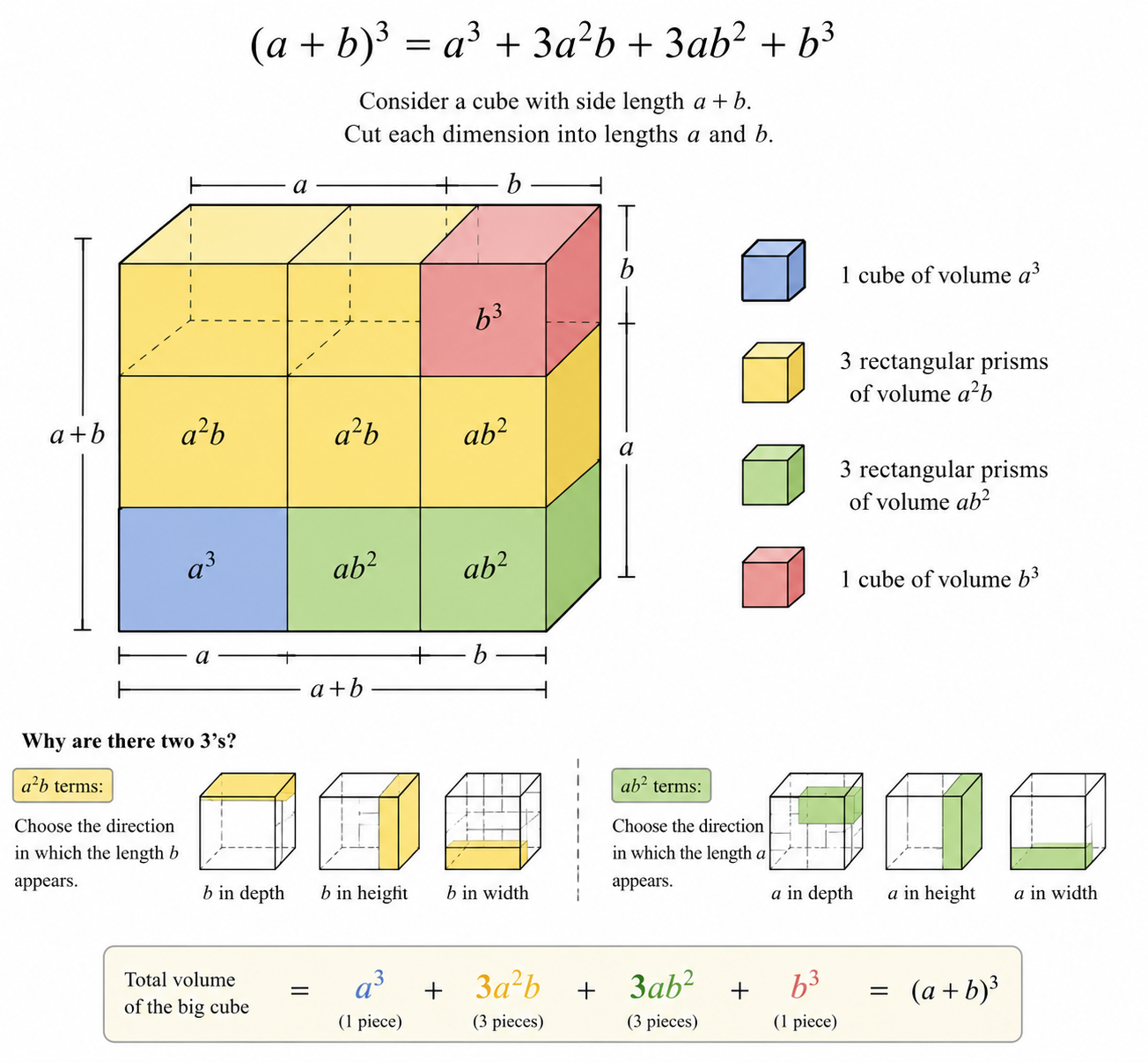
Geometric view of the identity .
Unfortunately, modern education often discourages this kind of thinking. Students are rewarded for speed rather than depth, completion rather than understanding, confidence rather than investigation. Practice is important, but practice without understanding can turn mathematics into performance. Confusion is treated as weakness, even though confusion is often the starting point of genuine insight.
As a result, many students quietly develop a dangerous belief:
Math is a collection of rules invented by smarter people.
Once this belief takes root, math becomes something external and untouchable. The student no longer sees themselves as a thinker. They become a consumer of methods rather than a discoverer of ideas.
But mathematics was never meant to be received passively.
Every theorem was once an unsolved mystery. Every elegant proof emerged from uncertainty, experimentation, failed attempts, and long periods of thought. The subject itself was built by people asking questions nobody had answered before.
The students who truly grow in math are usually not distinguished by extraordinary speed. More often, they are distinguished by patience. They are willing to sit with a difficult problem longer than others. They experiment with unfamiliar ideas. They make mistakes without immediately giving up. They search for structure inside confusion.
Slowly, almost invisibly, they begin to develop something rare: mathematical intuition.
At some point, mathematics stops feeling like schoolwork and starts feeling like discovery. Problems become less about arriving at answers and more about understanding structures. A beautiful solution no longer feels like a trick. It feels inevitable in hindsight.
That is the turning point.
Deep problem solving, including competitive mathematics at its best, offers students a glimpse of this richer world. A beautiful Olympiad problem can teach far more than pages of repetitive exercises because it demands creativity, flexibility, and independent thought. It forces students to think rather than imitate.
A single deep problem can change the way a student approaches learning altogether.
At its best, mathematics teaches something far more valuable than technique. It teaches patience, clarity, skepticism, creativity, and the ability to remain thoughtful in the presence of difficulty.
These qualities cannot be developed through memorization alone.
They emerge slowly through struggle, curiosity, and sustained thought.
Students do not truly learn math by memorizing solutions. They begin to learn math when they start asking why those solutions work.
How did this essay land?
Choose any responses that capture your reading.
3 is prime